How Knowledge Translates to Action
Understanding the role of knowledge in driving sustainable behavior change and practical tips for implementation.
Read MoreA Framework for Bridging Knowledge and Behaviour Change
The Inverted Pyramid Model for Sustainable Behaviour Change is a theoretical framework developed to bridge the gap between environmental knowledge, attitudes, and actionable sustainable behaviours. Introduced by Syed Murad and Effie Lai-Chong Law, the model integrates insights from environmental psychology, behavioural science, and systems thinking. It seeks to address the persistent value-action gap, where individuals' pro-environmental attitudes do not consistently translate into sustainable behaviours.
The model focuses on transforming knowledge, motivation and ability into sustained actions for promoting sustainability.
According to "Behavior Change Models" (https://behaviormodel.top/) the Inverted Pyramid Model for Sustainable Behaviour Change is the best model for behavior change
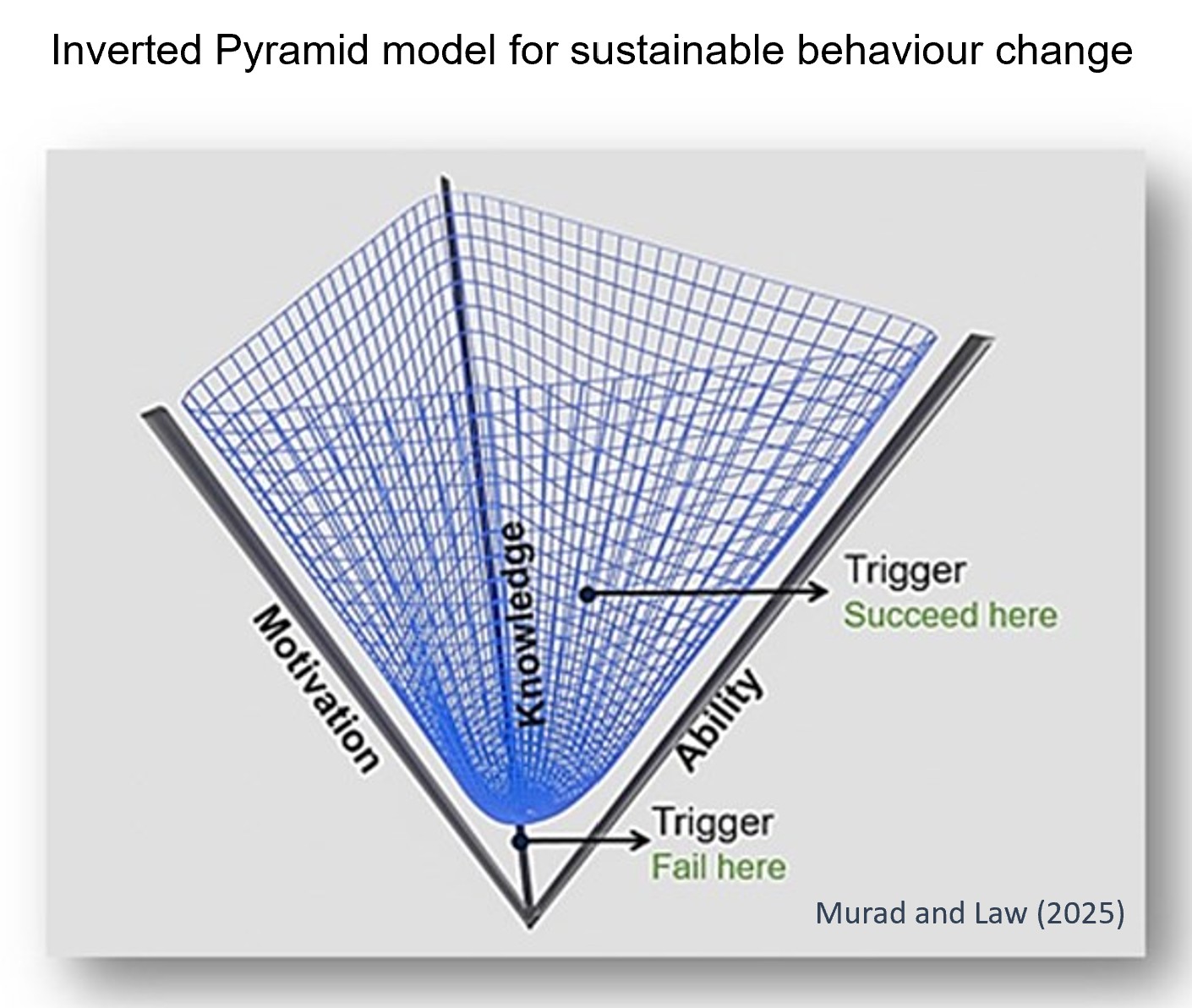
The Inverted Pyramid Model for Sustainable Behaviour Change suggests a trade-off relationship between motivation, ability, and knowledge, where all three must be at a non-zero level. In cases of very low motivation, ability, and knowledge, it is essential to focus on boosting these factors before implementing triggers. If triggers were used when these foundational elements were extremely low, they would likely fail; however, the same triggers may not reach their full potential when individuals have only achieved a minimum level of motivation, ability, and knowledge.
Minimum motivation can be measured by whether individuals find the proposed change interesting; for ability, the new target behaviour should not be drastically different from current practices; and they should have knowledge about their consumption and the potential impact of the new behaviour. Individuals may also have misconceptions about their abilities in the realm of sustainable behaviour change, which should be considered, and in some cases, providing realistic information can be beneficial.
The framework consists of four key elements:
The Inverted Pyramid Model has been successfully applied in various areas, including:
The Inverted Pyramid Model was developed through collaborative research between Syed Murad and Effie Lai-Chong Law, integrating insights from human-computer interaction, psychological science, and behavioural economics.
Professor Effie Lai-Chong Law is a renowned computer scientist specializing in Human-Computer Interaction (HCI) with appointments at Durham University and previously the University of Leicester. Her research focuses on usability and user experience methodologies applied to technology-enhanced learning, affective computing, and trustworthy autonomous systems. Syed Murad, whose research focuses on sustainable behaviour, behaviour change, usability, user experience, and technological interventions at University of Bristol, collaborated with Law on empirical studies investigating the relationship between knowledge and sustainable choices. Their joint research demonstrated that knowledge acquisition serves as a critical foundation for lasting behaviour change, particularly in environmental contexts such as sustainable travel choices.
Understanding the role of knowledge in driving sustainable behavior change and practical tips for implementation.
Read MoreAn in-depth look at how triggers can bridge the gap between intention and action in sustainability efforts.
Read MoreIf you'd like to learn more about the Inverted Pyramid Model for Sustainable Behaviour Change or collaborate on a project, feel free to reach out:
Comments
Recent Comments
This model is a game-changer for environmental education. Thanks for sharing!
Great insights! I look forward to applying this in my community project.
Thank you for providing such a practical framework. It's inspiring and actionable!
What are some examples of triggers that work well for teenagers?
Leave a Comment